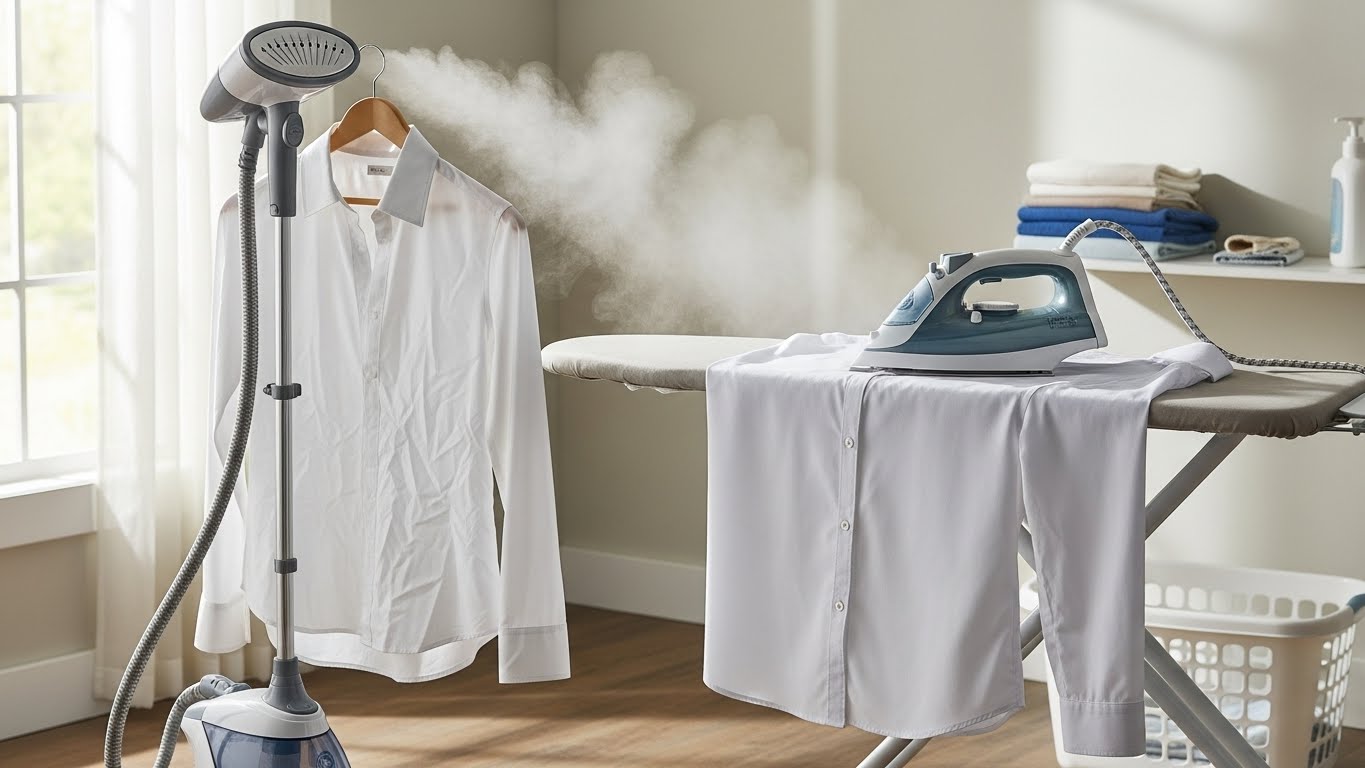
If you’re torn between buying a clothes steamer or an iron, you’re not alone. Both remove wrinkles, but they work differently—and the “best” choice depends on your wardrobe, how picky you are about sharp creases, and whether you travel a lot.
This guide breaks down wrinkle-removal performance, fabric safety, speed, convenience, and travel practicality so you can choose confidently (and avoid damaging your clothes).
Quick Answer: Which One Should You Buy?
Choose a clothes steamer if you:
- Wear lots of delicates (silk, chiffon, viscose, lace) or knits
- Want fast touch-ups for everyday outfits
- Hate setting up an ironing board
- Need something travel-friendly
- Mostly care about “looks smooth,” not “razor-sharp creases”
Choose an iron if you:
- Want crisp collars, pleats, seams, and professional creases
- Wear lots of cotton shirts, linen, denim
- Need strong performance on deep wrinkles
- Prefer precise control (steam bursts + pressure)
Best for most households: If you can only get one, an iron is more versatile. If you dress in delicates or travel often, a steamer may feel more useful day-to-day.
Clothes Steamer vs. Iron: Key Differences
1) Wrinkle Removal: Who Wins?
Iron = stronger wrinkle removal on thick fabrics and deep creases.
Irons combine heat + steam + pressure (pressing the fibers flat). That pressure is why irons produce the cleanest finish.
Steamer = faster for light-to-medium wrinkles and quick refresh.
Steam relaxes fibers without direct pressure, which is perfect for soft fabrics—but it can struggle with stubborn wrinkles on cotton/linen or anything folded hard in a drawer.
Rule of thumb
- Deep wrinkles / crisp look: iron
- Quick smoothing / gentle fabrics: steamer
2) Fabric Safety: Which Is Gentler?
Steamer is generally safer because you don’t press a hot plate directly onto fabric. That means lower risk of:
- Shine marks on dark fabrics
- Scorching
- Flattening texture (like some knits)
Iron is safe when used correctly, but more user skill is involved:
- Wrong temp = melted synthetics (polyester blends can be unforgiving)
- Too much pressure = shine on wool/dark cotton
- Dirty soleplate = stains
If your closet is mostly:
- Silk, chiffon, rayon/viscose, lace, wool blends, knits: steamer is your safer default
- Cotton, linen, denim: iron is usually the better tool (with correct settings)
3) Crispness: Collars, Pleats, and Seams
This is where irons dominate.
Iron gives structure. Great for:
- Dress shirts (collars/cuffs)
- Pleats
- Trouser creases
- Hemlines and seams
- Quilting/crafting
Steamer gives softness. Great for:
- Drapey dresses
- Blouses
- Sweaters
- Curtains
- Clothes you don’t want to “flatten”
If you care about looking “tailored,” you’ll appreciate an iron.
4) Speed & Convenience: Real-Life Use
Steamer can be faster overall for daily wear:
- Plug in
- Hang garment
- Steam for 1–3 minutes
No board, no setup.
Iron can be faster per wrinkle once you’re set up:
- One pass can flatten a stubborn area instantly
But the setup (board + positioning + turning garments) adds time.
Typical experience
- Steamer: faster for 1–3 items “before you leave”
- Iron: better for batching a week’s worth of shirts
5) Travel: What Works Best on the Road?
Travel steamer is usually the winner, but not always.
Steamer pros for travel
- No ironing board needed
- Great for hotel-hung clothes
- Quick touch-ups
Steamer travel downsides
- Some are underpowered (takes longer)
- Water can leak if tossed in luggage
- International travel: voltage compatibility matters
Iron travel pros
- Small travel irons can press collars and hems better
- Many hotels already have an iron available (quality varies)
Travel recommendation
- Frequent travelers: pack a compact steamer (or rely on hotel iron if you need crisp shirts)
- Business travel with dress shirts: consider a mini iron or a steamer + wrinkle-release spray combo
What to Buy: Features That Actually Matter
If You’re Buying a Clothes Steamer
Look for:
- High steam output (strong continuous steam matters more than “watts”)
- Fast heat-up time (under ~45 seconds feels convenient)
- Leak-proof design (important for travel and angled use)
- Long cord and comfortable grip
- Auto shut-off (safety + peace of mind)
Nice-to-have:
- Heated steam plate (helps wrinkles fall faster)
- Adjustable steam levels (better for delicates)
Avoid:
- Very tiny tanks if you’ll steam multiple items daily
- No-name units with frequent leaking complaints
If You’re Buying an Iron
Look for:
- Strong steam burst and good continuous steam
- Precision tip (for buttons and collars)
- Auto shut-off
- Anti-drip + anti-calc features (reduces water spotting and buildup)
Soleplate notes:
- Smooth glide matters. If it drags, ironing becomes a chore.
- If you iron a lot, choose a model known for even heat distribution.
Fabric-by-Fabric: Steamer or Iron?
Silk / chiffon / satin: ✅ Steamer (lowest risk)
Wool / cashmere: ✅ Steamer (avoid shine; use light tension)
Rayon/viscose: ✅ Steamer (gentle; avoid scorching)
Polyester blends: ✅ Steamer or low-temp iron (test first)
Cotton shirts: ✅ Iron (best crispness)
Linen: ✅ Iron (deep wrinkles) + steam burst
Denim: ✅ Iron (needs pressure)
Knit sweaters: ✅ Steamer (don’t flatten)
Structured garments (pleats, creases): ✅ Iron
Tip: If you only own a steamer and need a sharper finish, steam first to relax wrinkles, then press quickly with an iron on the right temp.
Common Mistakes (And How to Avoid Them)
Steamer mistakes
- Pressing the nozzle hard into fabric → can leave water marks or over-wet areas
✅ Keep it slightly off the fabric unless the steamer is designed for contact steaming. - Over-steaming delicate fabrics → can stretch or warp
✅ Use light passes and let the garment cool while hanging.
Iron mistakes
- Too hot for synthetics → shiny spots or melting
✅ Start low, increase gradually; use a pressing cloth if unsure. - Dirty soleplate → stains
✅ Clean periodically; don’t iron over printed decals without protection.
Which Is Better for You? (Simple Decision Checklist)
Choose a steamer if you say yes to 3+:
- I wear delicates/knits often
- I need quick morning touch-ups
- I travel frequently
- I hate ironing boards
- I mostly want wrinkles “gone enough,” not crisp
Choose an iron if you say yes to 3+:
- I wear cotton/linen shirts often
- I want crisp collars and creases
- I batch iron laundry weekly
- I need to press seams/pleats
- I’m okay with setup for the best finish
Best of Both Worlds: Do You Need Both?
Many people end up happiest with both:
- Steamer for everyday dresses, tops, delicate fabrics, quick refresh
- Iron for shirts, uniforms, formalwear, and anything structured
If budget is tight: buy the one that matches your most common clothes, not the one that’s “technically better.”
FAQ
Is steaming better than ironing?
Steaming is gentler and often more convenient. Ironing is more powerful and creates sharper results.
Can a steamer replace an iron?
For many casual wardrobes, yes. But if you need crisp creases, collars, pleats, a steamer won’t fully replace an iron.
Do steamers sanitize clothes?
Steam can reduce odors and may lower surface microbes, but it’s not a guaranteed sterilization method. For true sanitation, follow fabric care instructions (washing/drying at appropriate temps).
What’s best for travel?
A compact steamer is easiest for quick wrinkle removal without a board. For business shirts, a mini iron can be better for collars and cuffs.