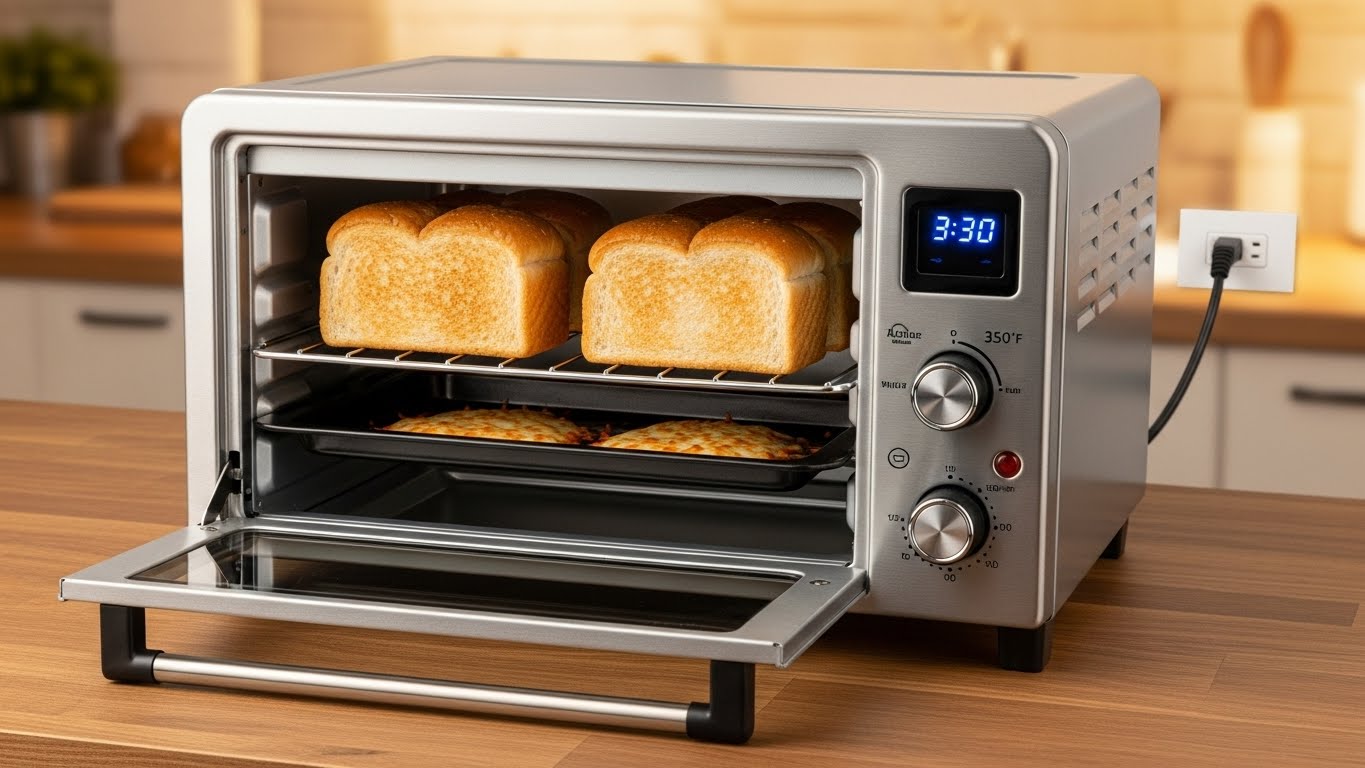
A toaster oven can be the most-used appliance in your kitchen—if you buy the right size and features for how you actually cook. Choose wrong, and you’ll end up with something that doesn’t fit your counter, can’t handle your favorite foods, or wastes energy.
This guide walks you through size, key functions, countertop space, and energy use, plus practical tips so you can pick a toaster oven that feels “made for your kitchen.”
Quick Answer: The Best Toaster Oven Is the One That Fits Your Food + Your Space
Pick a compact toaster oven if you:
- Mostly toast bread, reheat leftovers, bake small snacks
- Have limited counter space
- Cook for 1–2 people
Pick a mid-size (most popular) if you:
- Want a true “mini-oven” for daily cooking
- Reheat pizza, bake cookies, roast veggies, air-fry occasionally
- Cook for 2–4 people
Pick a large / family-size if you:
- Need to fit a 9×13 pan, large casserole, or multiple trays
- Cook for 4+ people
- Want to replace your full-size oven for many meals
1) Size: What “Capacity” Really Means
Toaster ovens are usually described by what they can fit:
- Slices of bread (2, 4, 6 slices)
- Pizza size (8″, 10″, 12″)
- Pan size (8×8, 9×9, 9×13)
- Sometimes cubic feet / liters (less intuitive)
Practical sizing guide (choose based on what you cook)
- Toast + small reheats: 2–4 slice / 8″ pizza
- Typical daily cooking: 4–6 slice / 10–12″ pizza
- Meal prep / family: fits 9×13 pan or two racks
Pro tip: If you reheat pizza often, make “fits my usual pizza slice layout” a requirement. A toaster oven that technically fits a 12″ pizza but only with a tiny tray can be frustrating.
Don’t forget interior height
Many people overlook this:
- Want to roast chicken pieces or tall bakes? You need enough headroom so food doesn’t sit too close to the top heating elements.
2) Measure Countertop Space (The Step People Skip)
Before you fall in love with features, measure:
- Width x depth of the space you’ll put it
- Clearance behind it (for heat/ventilation)
- Clearance above it (especially under cabinets)
Easy countertop checklist
- Can the door open without hitting anything?
- Can you pull the rack out safely without bumping a wall?
- Is there room to access the controls comfortably?
- Do you have space for hot trays to land?
Ventilation note: Many toaster ovens vent heat out the back or top. If you’re placing it under cabinets, prioritize units known for good heat management and follow the manufacturer clearance guidance.
3) Functions: Which Ones Matter (and Which Are Optional)
Most toaster ovens include some combination of:
Must-have basics (for most people)
- Toast + Bake + Broil
- Temperature control that feels stable
- Timer with auto shut-off
- Even heating (more important than fancy modes)
Super useful upgrades (worth paying for if you’ll use them)
- Convection (fan-assisted baking):
Helps crisp and cook more evenly. Great for fries, veggies, and reheating pizza. - Air Fry mode:
Basically strong convection with specific presets. Nice if you want crunchy results without buying a separate air fryer. - Reheat / Warm:
Handy for leftovers without overcooking. - Dehydrate:
Only if you actually make dried fruit/jerky (otherwise ignore). - Proof / slow cook:
Useful for bread bakers, but not essential.
“Nice in theory” features you can skip
- Too many presets you won’t remember
- Smart app controls (unless you truly want remote monitoring)
- Rotisserie (fun, but often bulky and rarely used)
Recommendation: Pay for better heating + build quality before paying for 20 extra presets.
4) Heating Performance: The Real Difference Between Cheap and Great
A great toaster oven:
- Preheats reasonably fast
- Browns evenly (toast isn’t pale on one side)
- Doesn’t scorch the edges while leaving the middle soft
- Holds temperature decently (less hot/cold cycling)
What affects this:
- Convection fan quality
- Heating element placement
- Insulation
- Rack positions
- Interior size vs element power (bigger box needs more oomph)
If you’re shopping online, look for reviews mentioning:
- “Even toast”
- “No hot spots”
- “Accurate temperature”
- “Consistent browning”
5) Energy Use: How to Think About It (Without Getting Overly Technical)
Toaster ovens can use less energy than a full-size oven for small meals because:
- Smaller space to heat
- Faster preheat
- Shorter cook times for small portions
But energy use depends on:
- Wattage
- Cooking time
- How often it cycles on/off
- How well it’s insulated
Practical energy tips
- If you cook small portions daily, a toaster oven often saves energy vs a large oven.
- Convection/air fry can reduce cook time, which may reduce total energy used.
- Choose the smallest oven that fits your typical meals—oversized models can waste energy when used for tiny tasks.
Real-life rule: If you’re cooking “one tray of something,” toaster oven usually wins. If you’re cooking multiple racks for a big family meal, the full-size oven may be more efficient.
6) What You’ll Cook Most: Match the Oven to Your Habits
If you mainly toast bread
Prioritize:
- Even browning
- Multiple toast shades that actually differ
- A toast mode that doesn’t burn one side
If you reheat leftovers and pizza
Prioritize:
- Convection/reheat mode
- Interior space for slices/containers
- Crumb tray that’s easy to clean
If you bake often
Prioritize:
- Stable temperature
- Multiple rack positions
- Fits your favorite pans
If you want crunchy “air fryer” results
Prioritize:
- Strong convection / air fry mode
- Basket/tray designed for airflow
- Easy cleaning (air fry can get greasy)
7) Cleaning & Maintenance: Don’t Underestimate This
Toaster ovens get messy fast. Look for:
- Removable crumb tray (front-access is nice)
- Nonstick interior (helpful, but still needs care)
- Included trays that are easy to replace
- Fewer gaps where grease can hide
If you air-fry frequently, cleaning becomes a bigger deal—choose something with easy-to-remove accessories.
8) Controls: Digital vs Knobs (Choose What You’ll Actually Use)
Knobs
- Simple, durable, easy to use
- Great if you hate menus
- Less precise timing sometimes
Digital
- More precise temps/timers
- Often includes more presets
- Can be slower to operate for quick toast
Pick the style that fits your personality. The “best” toaster oven is the one you’ll use daily without annoyance.
9) Safety & Convenience Features Worth Having
- Auto shut-off (strongly recommended)
- Cool-touch handle (nice if kids are around)
- Interior light (underrated)
- Non-slip feet (stability matters)
- Cord length that fits your outlet location
A Simple Buying Checklist (Copy/Paste)
Before buying, confirm:
- Fits my counter space (width/depth + door clearance)
- Fits my most common food (pizza size, pan size, interior height)
- Has bake/broil/toast + timer auto shut-off
- Convection/air fry only if I’ll use it weekly
- Easy crumb tray + easy-to-clean accessories
- Reviews mention even browning and stable heat
FAQ
What size toaster oven do most people need?
Most households do best with a mid-size model that fits a 10–12″ pizza and a small baking pan, unless you cook for 4+ people.
Is “air fry” on a toaster oven the same as an air fryer?
It’s similar (strong convection + airflow), but results vary. Dedicated air fryers can be faster for small batches, while toaster ovens are more versatile for baking and reheating.
Will a toaster oven replace my regular oven?
For many day-to-day meals—yes. For large roasts, big batches, or multiple racks, your full-size oven still wins.